Reference page · Updated
Published by Middle Corridor Network, an independent research publication · Gökhan Köse · Imprint
Middle Corridor
The Middle Corridor, officially the Trans-Caspian International Transport Route (TITR), is the rail and sea route from the border with China through Kazakhstan, across the Caspian Sea, through Azerbaijan and Georgia to Türkiye and on to Europe. It is also called the Trans-Caspian corridor, Orta Koridor in Turkish and ТМТМ in Russian.
- 6,180 km
Rail and feeder vessel from Altynkol on the China border to Istanbul
TITR tariff 2026, table 3, no. 7 - 10 days
Transit time on the same route according to the tariff
TITR tariff 2026, table 3, no. 7 - 3,861 USD
Tariff per loaded 40-foot container, Altynkol to Istanbul
TITR tariff 2026, table 3, no. 7 - 77,000 TEU
Containers on the route in 2025, approximately
Ministry of Transport of Kazakhstan, 10 March 2026
Night map
Middle Corridor map
 Istanbul
Poti
Kars
Alat · Baku
Aktau
Altynkol · Khorgos
 Istanbul
Poti
Kars
Alat · Baku
Aktau
 Aktau
Altynkol · Khorgos
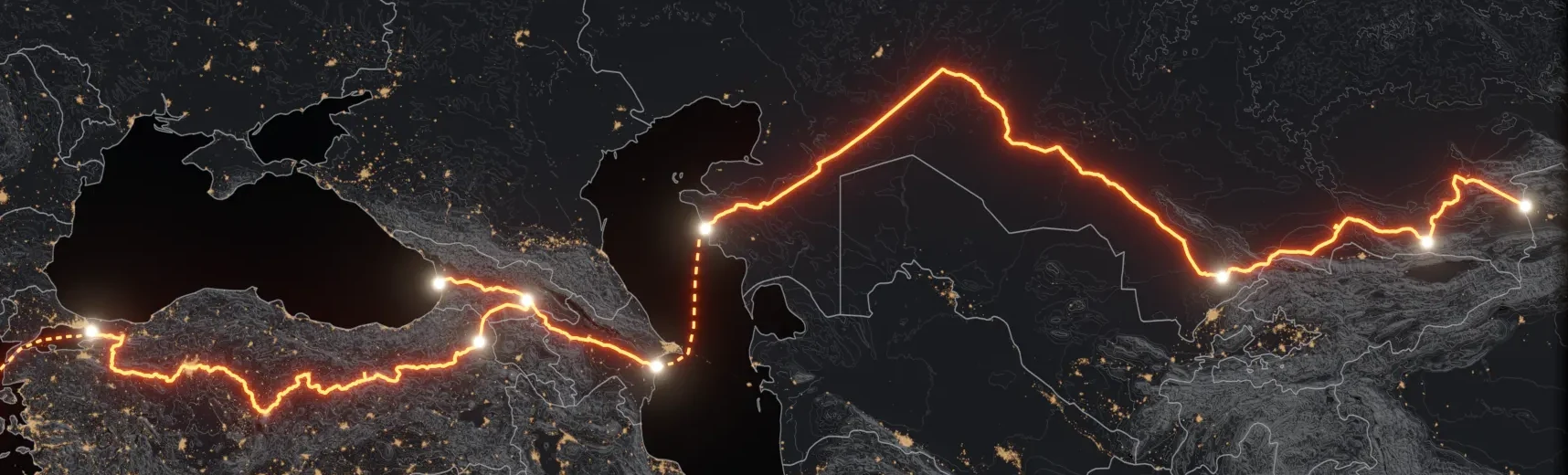
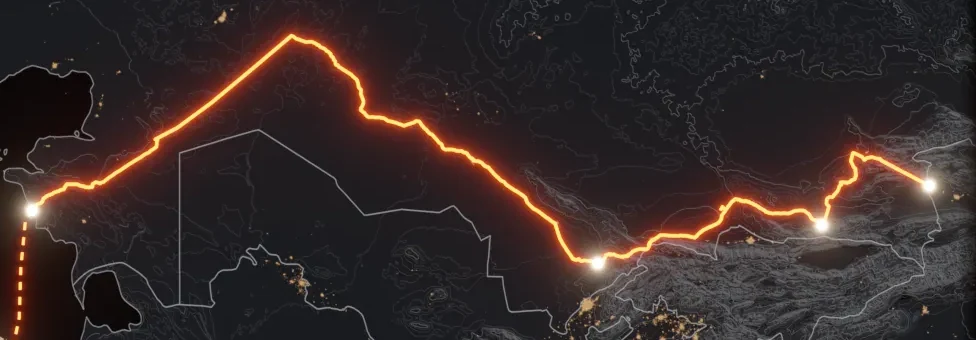
The Middle Corridor at night, from Istanbul across Georgia, Azerbaijan and the Caspian Sea through Kazakhstan to Altynkol on the border with China, with the stations from the route diagram below. Dostyk lies east of the frame.
Image: own render from terrain relief (AWS Terrain Tiles), night lights (NASA Black Marble 2016) and railways (Natural Earth)
Network view
Why the Middle Corridor matters
China is the world's factory; that does not mean everything is made in China alone. Distance and time impose a certain geographic distribution of production. The Organization of Turkic States is the frame along the route: at its Bishkek summit in 2024 the heads of state instructed their ministries to establish scheduled block trains along the Middle Corridor [16]. Türkiye, at mid-distance between China and Europe, is a complementary production and distribution base. Italy and Spain open the Mediterranean.
- 27.4 %
China's share of world manufacturing value added, 2025
World Bank, own calculation [13] - 229 bn USD
Manufacturing value added of Türkiye, 2024
World Bank [14] - 217.6 bn EUR
EU goods trade with Türkiye in 2025, the EU's fifth-largest trading partner
European Commission, DG Trade [15]
Diagram · Route
Middle Corridor route, section by section
The route runs by rail from the Chinese border across Kazakhstan to the Caspian ports, by ship across the Caspian Sea to Alat near Baku, and by rail through Georgia to Türkiye, with a branch to the Black Sea ports of Poti and Batumi. It has seven sections:
- China border: border stations Altynkol (Khorgos) and Dostyk; the gauge change took 1 to 10 days as of 2022 [4].
- Kazakhstan: Dostyk–Aktau by rail, 3,095 km in 114 hours, USD 1,250 per loaded 40-foot container [2].
- Aktau and Kuryk: the port of Aktau has a handling capacity of 11.8 million tonnes [6]; unloading and waiting took up to 10 days in 2020–21 [4].
- Caspian Sea: the crossing takes about 1.5 days, waiting for a full load 3 to 5 days, as of before 2022 [4].
- Alat near Baku: 3,654 km and 5 days from Altynkol, USD 2,498 [1]; unloading took 2 to 3 days as of 2022 [4].
- Caucasus: the Baku–Tbilisi–Kars railway, 850 km, opened on 30 October 2017 [5]; at Gardabani a branch leads to Poti and Batumi, 4,479 km and 7 days from Altynkol, USD 2,998 [1]; waiting in the port of Poti took 2 to 10 days as of 2022 [4].
- Türkiye: Istanbul is 6,180 km and 10 days from Altynkol, USD 3,861 [1]; at the Akhalkalaki–Kars border cargo is reloaded from wagon to wagon, at a cost not included in the tariff [3].
Kilometres, transit times and tariffs “from Altynkol” come from the 2026 through tariffs of the TITR Association for a loaded 40-foot container by feeder vessel via Alat, which according to the tariff are subject to weather-related delays at the ports of the Caspian and the Black Sea; the bottleneck figures come from the OECD report of 2023 with data up to 2022.
Table · Countries
Middle Corridor countries
On the TITR tariff route from Altynkol to Istanbul the Middle Corridor crosses Kazakhstan, Azerbaijan, Georgia and Türkiye, starting at the border with China [1]. Across the Caspian Sea, Azerbaijan is also linked with Turkmenistan and Uzbekistan: the first eTIR transports between the three countries ran in July 2026 [9].
| Country | On the route | Track gauge | Rail freight law | e-CMR, road |
|---|---|---|---|---|
| China | origin, border with Kazakhstan | 1,435 mm | SMGS | – |
| Kazakhstan | border stations Altynkol and Dostyk, rail to the ports of Aktau and Kuryk | 1,520 mm | SMGS | no |
| Azerbaijan | port of Alat near Baku, rail to Georgia | 1,520 mm | CIM and SMGS | yes, acceded 27 December 2022 |
| Georgia | rail to Akhalkalaki, branch at Gardabani to the Black Sea ports of Poti and Batumi | 1,520 mm | CIM and SMGS | no |
| Türkiye | rail from Kars to Istanbul | 1,435 mm | CIM | yes, acceded 31 January 2018 |
Chart · Tariff 2026
Middle Corridor transit time and tariffs 2026
A loaded 40-foot container costs USD 3,861 from Altynkol on the China border to Istanbul and takes 10 days for 6,180 km, according to the TITR through tariff 2026 [1]. The run from the place of loading in China to Altynkol comes on top.
Start Dostyk · own tariff
- Dostyk → Aktau1,250 USD3,095 km · 114 h · table 2 [2]
Start Altynkol · through tariff
- Altynkol → Alat2,498 USD3,654 km · 5 days · table 3, no. 1 [1]
- Altynkol → Poti / Batumi2,998 USD4,479 km · 7 days · table 3, no. 5 [1]
- Altynkol → Istanbul3,861 USD6,180 km · 10 days · table 3, no. 7 [1]
Tariff per loaded 40-foot container, bars on a scale from 0 to 4,000 USD; the hollow bar starts in Dostyk instead of Altynkol. In Türkiye, wagon-to-wagon reloading and border clearance are not included.
Source: TITR tariff 2026, table 3, no. 1, 5, 7 and notes · table 2
Practice for shippers
Middle Corridor logistics: documents, gauge changes, ferries
Three handovers where cargo changes wagon or mode: the gauge change at Altynkol, the ferry or feeder across the Caspian Sea, and the gauge change with reloading between Akhalkalaki and Kars.
Sources: OECD 2023, pp. 63, 94, 104 [4] · UN Treaty Collection, e-CMR [8] · IRU, 27 July 2026 [9] · TITR tariff 2026, tables 3, 5, 6 [1] [10] [3]
Tariff and practice
The tariff counts from station to station, the shipping line from port to port, the shipper from door to door. Each figure below states which of the three it measures.
- 10 days
Tariff time Altynkol to Istanbul, station to station
TITR tariff 2026, table 3, no. 7 [1] - 27 days
By sea Yantian to Istanbul, port to port
Maersk, Trans Suez [20] - 47–50 days
Via the corridor East Asia to Europe, door to door; about 45 by sea
World Bank 2026, p. xxxvii [12] - 55 %
Share of the transit time spent in seaports, Black Sea branch, Chongqing to Budapest, 2023
World Bank 2026, p. 75 [17]
The World Bank rates the corridor as not yet competitive: longer delivery times at higher transport costs than the sea routes. Its model brings door to door down to 18 to 19 days by 2040 [12]. The gauge change at the China border now takes about 2.6 hours in Khorgos and 6.3 hours in Dostyk [18]; the one to ten days in the OECD report are as of 2022 [4]. In the port of Alat, containers stood 25 days on average in 2022, between 10 and 46 days [19].
Chart · Volumes
Middle Corridor volumes: 1.87 or 4.5 million tonnes?
- TITR Association1.87 Mtyear 2025 · volume chart on middlecorridor.com [11]
- Ministry of Transport of Kazakhstan4.5 Mtper year · press release of 10 March 2026 [7]
Same route, same unit, a factor of 2.4 between the two figures; scale 0 to 5 million tonnes. The ministry gives no reference year for the 4.5 million tonnes, and neither source explains the difference.
Sources: TITR Association, volume chart 2017–2025 · Ministry of Transport of Kazakhstan, 10 March 2026

Bulletin
Middle Corridor Bulletin
Monthly, by e-mail: what was announced on the corridor, what was actually built, and where it is still slow.
Data or practice experience to share? Write to editor@middlecorridor.net.
Unsubscribe at any time with a reply. See privacy.
Glossary
Middle Corridor glossary
- TITR
- Trans-Caspian International Transport Route, the official name of the Middle Corridor. The International Association “TITR” publishes the through tariffs on middlecorridor.com; its working group adopted the 2026 tariffs on 5 December 2025 [1].
- Altynkol and Dostyk
- The two Kazakh border stations on the border with China. The TITR through tariffs start at Altynkol (Khorgos) [1]; Dostyk has its own tariff to Aktau, 3,095 km [2].
- Gauge change
- China and Türkiye run on 1,435 mm track, Kazakhstan, Azerbaijan and Georgia on 1,520 mm [4]. Cargo therefore changes gauge at Altynkol and again between Akhalkalaki and Kars, where it is reloaded from wagon to wagon [3].
- Feeder and ferry
- Ships across the Caspian Sea between Aktau or Kuryk and Alat. The TITR through tariff runs by feeder vessel via Alat [1]; a separate tariff covers containers by ferry [10]. Both are subject to weather.
- CIM and SMGS
- The two rail freight law regimes on the route: CIM in Türkiye, SMGS in China and Kazakhstan, both in Azerbaijan and Georgia. The common CIM/SMGS consignment note counts as a CIM note in the CIM area and as an SMGS note in the SMGS area [4].
- e-CMR
- The electronic consignment note for international road transport under the CMR convention. Azerbaijan and Türkiye are parties, Kazakhstan and Georgia are not [8].
- eTIR
- The electronic form of the TIR customs transit system for road transport. The first eTIR transports across the Caspian Sea ran between Azerbaijan, Turkmenistan and Uzbekistan in July 2026 [9].
- BTK
- The Baku–Tbilisi–Kars railway, 850 km, opened on 30 October 2017. It links the Caspian port of Alat with the Turkish rail network [5].
- TEU
- Twenty-foot equivalent unit, the standard measure for container volumes. A 40-foot container counts as two TEU.
FAQ
Middle Corridor FAQ
What is the Middle Corridor?
The rail and sea route from the border with China through Kazakhstan, across the Caspian Sea, through Azerbaijan and Georgia to Türkiye, officially the Trans-Caspian International Transport Route (TITR). From Altynkol on the China border to Istanbul the tariff distance is 6,180 km (TITR tariff 2026, table 3, no. 7).
Which countries are on the Middle Corridor?
On the tariff route from Altynkol to Istanbul: Kazakhstan, Azerbaijan, Georgia and Türkiye, starting at the border with China (TITR tariff 2026, table 3, no. 7). Across the Caspian Sea, Azerbaijan is also linked with Turkmenistan and Uzbekistan (IRU, 27 July 2026).
How long does the Middle Corridor take from China to Türkiye?
According to the tariff, 10 days from Altynkol on the China border to Istanbul for a loaded 40-foot container by feeder via Alat, subject to weather at the ports (TITR tariff 2026, table 3, no. 7). The run from the place of loading in China to Altynkol is not included. The gauge change at the Kazakh border alone could take one to ten days (as of 2022, OECD 2023, p. 24); today the World Bank gives about 2.6 hours at Khorgos and 6.3 hours at Dostyk (World Bank 2026, p. 34). Door to door from East Asia to Europe, the corridor takes 47 to 50 days today and the sea route about 45 (World Bank 2026, p. xxxvii).
How much does it cost to ship a container on the Middle Corridor?
A loaded 40-foot container costs USD 2,498 from Altynkol to Alat, USD 2,998 to Poti or Batumi and USD 3,861 to Istanbul. In Türkiye, wagon-to-wagon reloading and border clearance are not included (TITR tariff 2026, table 3, no. 1, 5, 7 and notes).
What is TITR?
TITR stands for Trans-Caspian International Transport Route. The International Association “TITR” publishes the through tariffs on middlecorridor.com; its working group adopted the 2026 tariffs on 5 December 2025 (TITR tariff 2026, table 3). Middle Corridor Network is independent of it.
How much freight moves along the Middle Corridor?
Depending on the source, 1.87 million tonnes in 2025 (TITR Association) or 4.5 million tonnes per year (Ministry of Transport of Kazakhstan, 10 March 2026). For containers, the ministry reported about 77,000 TEU in 2025.
Which documents does a shipper need on the Middle Corridor?
By rail the CIM/SMGS consignment note, which counts as a CIM note in the CIM area such as Türkiye and as an SMGS note in the SMGS area such as China and Central Asia (OECD 2023, p. 63). By road TIR or eTIR (IRU, 27 July 2026); Azerbaijan and Türkiye are parties to the electronic consignment note e-CMR, Kazakhstan and Georgia are not (UN Treaty Collection).
Is Middle Corridor Network part of TITR?
No. Middle Corridor Network (middlecorridor.net) is an independent research publication on the Middle Corridor. It is not affiliated with the TITR Association (middlecorridor.com) or with Middle Corridor Logistics / Middle Corridor Lojistik A.Ş.
Sources
Sources
- TITR Association: through tariffs 2026 for containers by feeder vessel via Baku (Alat), table 3, no. 1, 5 and 7 with notes on weather and Türkiye
- TITR Association: 2026 tariff for containers Dostyk–Aktau, table 2
- TITR Association: 2026 tariff for wagon loads, table 6, note on transshipment at the Akhalkalaki–Kars border
- OECD: Realising the Potential of the Middle Corridor, December 2023: waiting times pp. 24, 99 and 100 (data 2020 to 2022), CIM and SMGS rail law pp. 61 and 63, track gauges pp. 92 and 102
- President of the Republic of Azerbaijan: opening of the Baku–Tbilisi–Kars railway, 30 October 2017
- Port of Aktau: handling capacity, retrieved November 2026
- Ministry of Transport of Kazakhstan: release of 10 March 2026, about 77,000 TEU in 2025 and 4.5 million tonnes per year
- United Nations Treaty Collection: Additional Protocol to the CMR concerning the electronic consignment note (e-CMR), list of parties, retrieved 8 November 2026
- IRU: first eTIR transports across the Caspian Sea between Azerbaijan, Turkmenistan and Uzbekistan, 27 July 2026
- TITR Association: 2026 tariff for containers by ferry across the Caspian Sea, table 5 with weather note
- TITR Association: chart “Transportation volume via TITR, thousand tons”, 2017 to 2025, retrieved 7 November 2026
- World Bank 2026: Integration: World-Class Trade Logistics Along the Trans-Caspian Transport Corridor, Overview p. xxxvii: door to door East Asia–Europe 47 to 50 days via the corridor and about 45 days by sea, “not yet competitive”, 18 to 19 days modelled for 2040
- World Bank: manufacturing, value added (current US$), China and world, 2025 (indicator NV.IND.MANF.CD); share calculated from USD 4.82 trillion and USD 17.60 trillion
- World Bank: manufacturing, value added (current US$), Türkiye, 2024 (indicator NV.IND.MANF.CD)
- European Commission, DG Trade: EU trade relations with Türkiye, goods trade 2025
- Organization of Turkic States: Bishkek Declaration, 2024 summit
- World Bank 2026: same report, p. 75: share of time in seaports on the Black Sea branch, Chongqing–Budapest, 2023
- World Bank 2026: same report, p. 34: gauge change at the China border, Khorgos and Dostyk
- World Bank 2023: Middle Trade and Transport Corridor, p. 43: container dwell time in the port of Alat (Baku), 2022
- Maersk: Shipping from Asia to Europe, Trans Suez network, table “Asia to Mediterranean”, Yantian–Istanbul, port to port, retrieved 18 November 2026